The Art and Identity of the Polička Kroj

By Karolina Dvorák
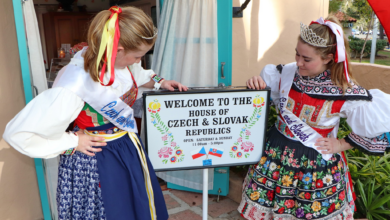
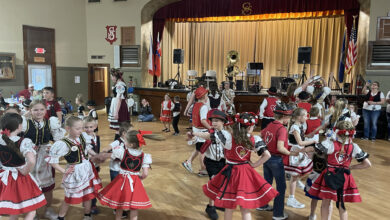
My mom has always called kroje “wearable art.” Kroje are traditional Czech and Slovak folk costumes, which were often worn on special occasions such as weddings, festivals, and church. Importantly, they also varied from region to region due to feudal estate laws that bound peasants to the land. From this emerged a tradition of unique, vibrant costumes.
I am lucky enough to possess a replica kroj from the region of Polička, in the bohemian-moravian highlands. My kroj was created from materials sourced in the Czech Republic, except the skirt.
The apron serves as the centerpiece of my kroj, featuring over 380,000 stitches that depict pastoral and floral motifs characteristic of the region. Flax and wheat dominate the upper rows of crisp, white embroidery, because they were staple crops in the Polička economy. Likewise, the flax industry’s regional predominance is why the kroj is composed completely of linen except the vest.
We hired someone to embroider my apron, which was often how it was traditionally done. In many parts of the Czech lands, each village had one or a couple people who were the most skilled embroiderers. These were often physically disabled people as it was a means of creating viable employment for them and through that– a social safety net.
The most meaningful embroidery is the linden tree motif on the waistband. It portrays the Czech and Slovak national trees as well as family lore about a village elder who clandestinely transcribed the psalms into Czech inside a hollowed-out linden because it was illegal during Hapsburg rule.
The “kolovanka”, or carousel, skirt exhibits crimson stripes lined up to the apron’s rows of embroidery. It is held in place by a “jiternice” or sausage (a stuffed roll of fabric) attached to the vest. While prior to the late 19th century stripe size would have decreased upwards mirroring the lines of embroidery, this traditional pattern is no longer produced and impossible to source, so my skirt’s stripes are consistent in width.
Like many regions, there were economic differences evident in kroje. Wealthier people likely wore the full kroj, but cottagers could’ve only afforded the skirt. Thus it was the most important aspect of Poličky kroje.
Above this is a blouse adorned with knotted lace and an emerald vest, which secures the shawl with vibrant, decorative lacing. Sewn by my sister Kate, it highlights how kroje were often a family effort. On the back, the shawl displays intricate floral whitework embroidery.
No kroj is complete without accessories. The black leather flats trimmed with silk ribbon are distinctive to this region, but would have only been worn on very special occasions. They were traditionally worn with cream or red stockings. Since I am unmarried, a silver-plated hairpin is worn rather than a white cap. This also signifies that my Polička kroj is recreated from an older time period since eventually even unmarried women began to wear the caps.
Whether it’s the specific region, financial or social status, or even the time period, the details in kroje have the power to paint a distinct portrait of the wearer. Therefore, kroje are not just a work of art because they are so beautiful. They also reveal one’s unique identity and heritage.