The Castle Ruins at Zlenice
By Kytka
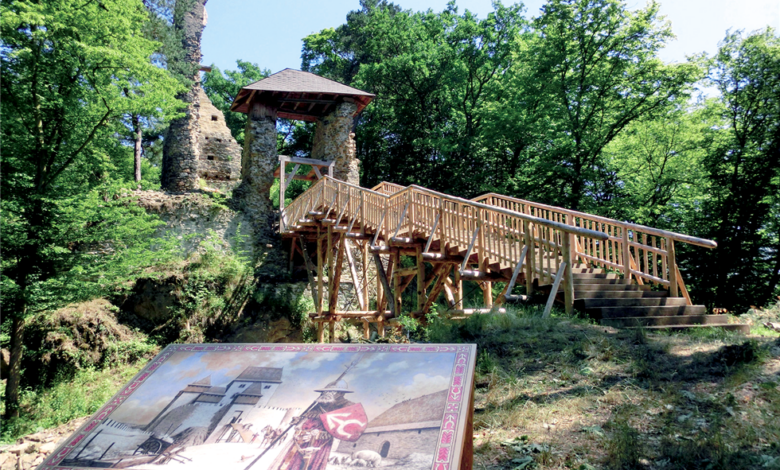
Just a short walk along the river from Čtyřkoly, past the whispering pines and the bend where the Mnichovický Brook meets the Sázava, the remains of Zlenice Castle (Zřícenina hradu Zlenice) rise from a rocky promontory. Today, it’s only a ruin — its great walls broken and softened by time — but this small fortress once stood as a proud sentinel over one of the most storied rivers in Bohemia.
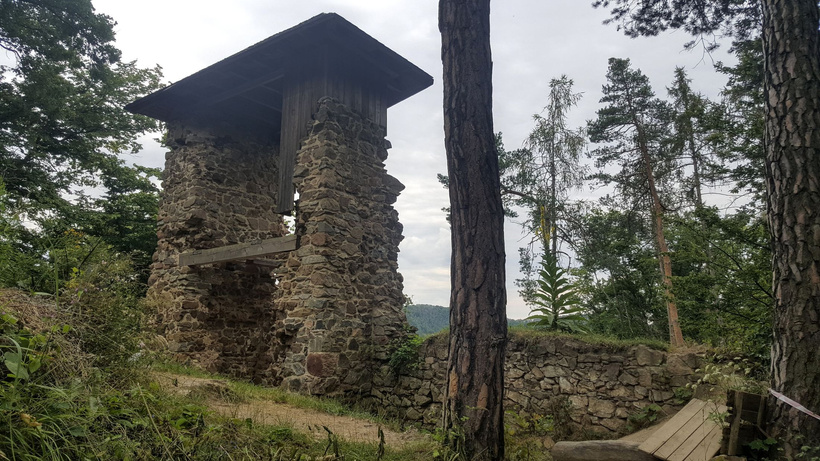
What remains is known simply as Hláska, “The Watchtower,” and it’s easy to see why. The surviving stone tower still looms over the valley, watching as the Sázava curves and sparkles below. Yet few realize that this quiet place, surrounded by moss and birdsong, carries with it nearly seven hundred years of Czech history.
Zlenice Castle was founded sometime after 1300, built on a natural rock spur high above the confluence of the Mnichovický potok and the Sázava River. The name Zlenice first appeared in written records in 1318, alongside Oldřich of Zlenice, one of its earliest lords. The castle took its name from an older settlement that once stood on the opposite riverbank — a village that later disappeared but lives on through the fortress that succeeded it.
The architecture we see in ruins today dates from the first half of the 14th century, a time when Bohemia flourished under King John of Luxembourg (Jan Lucemburský). Zlenice represented a typical nobleman’s residence of the Middle Ages — fortified yet intimate, balancing defense with domestic comfort.
By 1351, the estate was held by Jan of Zlenice, who took his name from the castle itself. That same year, he lost ownership as part of a loan arrangement with the brothers Štěpán and Ješek of Tetín — an early example of how politics, debt, and family fortunes intertwined in medieval Bohemia.
In the second half of the 14th century, Zlenice and the surrounding Posázaví region came into the hands of the powerful noble family of Dubá. One of its most distinguished members, Ondřej IV of Dubá and Zlenice (1361–1412), was not only a lord but also one of the most influential legal scholars of his time.
Ondřej IV served as the highest judge of the Czech Kingdom under King Charles IV and authored the Výklad na právo zemské české — the first comprehensive Legal Code of the Czech Lands. To this day, historians regard him as one of the pillars of Czech medieval law and governance.
Under his rule, Zlenice became a feudal property, and the castle likely prospered as both a noble residence and a local administrative center.
When Ondřej IV died in 1412, Zlenice passed to the Czech Crown and then shifted through a series of noble families during the turbulent 15th century — a period marked by the Hussite Wars and shifting allegiances.
The estate was acquired by Boček of Poděbrady and Půta of Častolovice, who in 1415 sold it to Kuneš of Konojedy. For a time, the Kuneš family held the property, but after his death, his daughter Běta lost it to Zdeněk Kostka of Postupice, sparking a prolonged dispute among creditors and heirs.
By 1456, the estate was sold to the Trčka of Lípa brothers, only to be bought back again in 1463 by Zdeněk Kostka himself. It was during his tenure — between 1464 and 1466 — that the castle’s final decline began. By 1465, Zlenice was officially described as “deserted and in ruins.”
From then on, it passed into the ownership of the Komorní Hrádek estate, and later to the Konopiště estate, where it was folded into broader aristocratic holdings. Its defensive days were over; Zlenice had become a romantic relic of a fading medieval world.
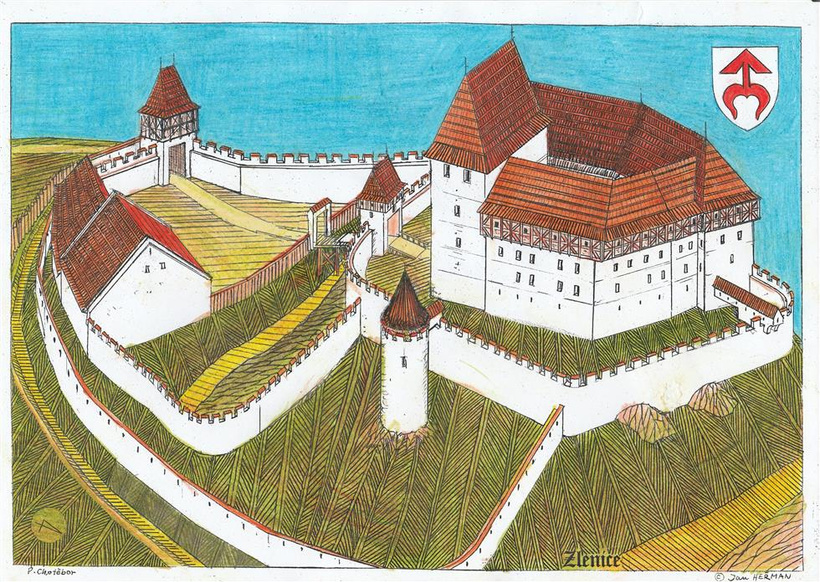
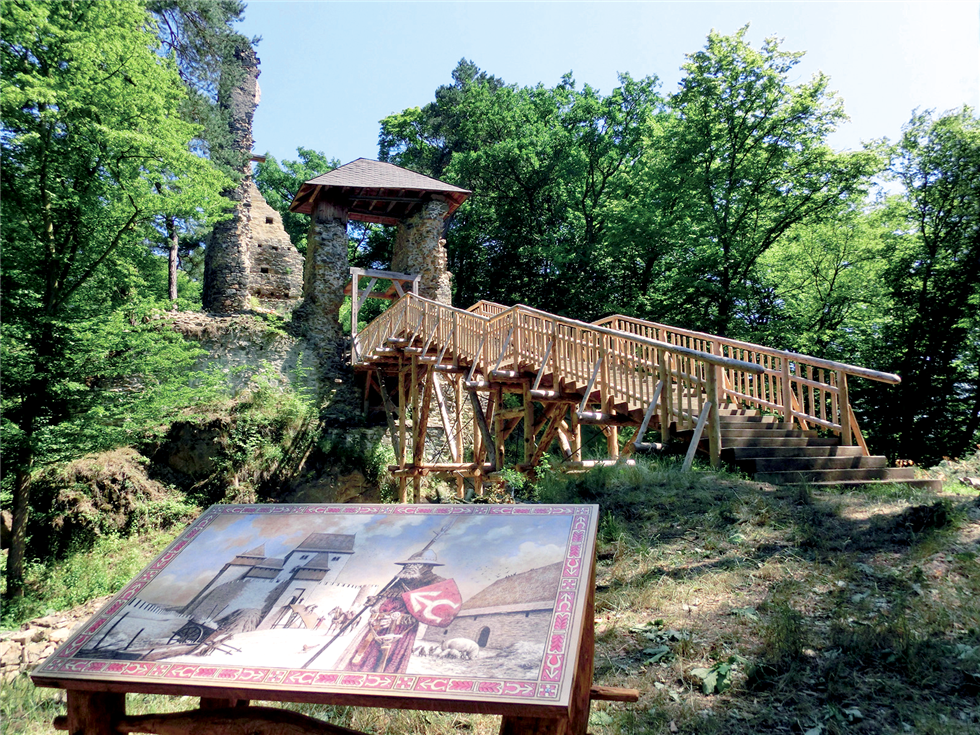
The remains of Zlenice tell us much about medieval castle design. The outer ward, or courtyard, was separated from the main castle by a wide, rock-hewn moat, once crossed by a drawbridge that could be raised for defense. The core of the castle was irregularly pentagonal in shape, with the main entrance passing through a square gate tower.
Traces of seating niches, window frames, and a bridge mechanism can still be seen in the preserved masonry. The central tower, now the ruin’s defining feature, once stood nearly 14 meters high with four floors, remnants of which survive on the northwest wall.
Visitors today can easily imagine the drawbridge lifting, guards pacing the rampart, and the Sázava glittering below — both a lifeline and a defense.
Like all good Czech ruins, Zlenice has its share of ghost stories. The most famous comes from Josef Svátek’s 19th-century novel Zlý duch Zlenic (The Evil Spirit of Zlenice), which tells of betrayal, vengeance, and a restless spirit haunting the castle’s shadowed corridors.
Though the tale is fiction, the romantic mystique it inspired remains. Locals say that when the fog settles low over the Sázava, the castle looks as if it’s floating above the clouds — as if the centuries themselves never quite let go.
How to Visit Today
Zlenice lies near Senohraby, about 30 kilometers southeast of Prague, and can be reached easily from Čtyřkoly by a pleasant 30–40 minute walk along the Sázava River hiking trail. The path winds through forested hillsides, over small wooden bridges, and finally opens to a clearing where the tower rises above the treetops.
The ruins are open year-round and free to visit. You’ll find information panels, river views, and plenty of quiet corners perfect for sketching, reflection, or simply letting the past sink in.
Places like Zlenice Castle embody the kind of history I love sharing — not the grand or gilded, but the intimate and enduring. This small fortress lived, ruled, and fell long before our time, but its stones still hold the memory of everything Bohemia once was — noble, turbulent, deeply human.
As mentioned in an earlier post, for some time, my father and grandmother lived nearby, in a little cottage above the Sázava. I often think how easily they might have walked this same trail, crossed the same bridge, or stood in the shadow of Hláska at sunset. I never visited them there — my children were too young then — and I’ve always been sorry I missed it.
Maybe that’s why I return to these stories: to walk the paths I couldn’t then, to keep the memory of these places alive.
Thank you for helping me do that here on Patreon — for keeping Czech history, family memory, and quiet beauty alive in every story we share.
Until next time,
Kytka & Richard
Kytka writes about lifestyle, literature, art and history. Find her at www.patreon.com/kytka/posts